


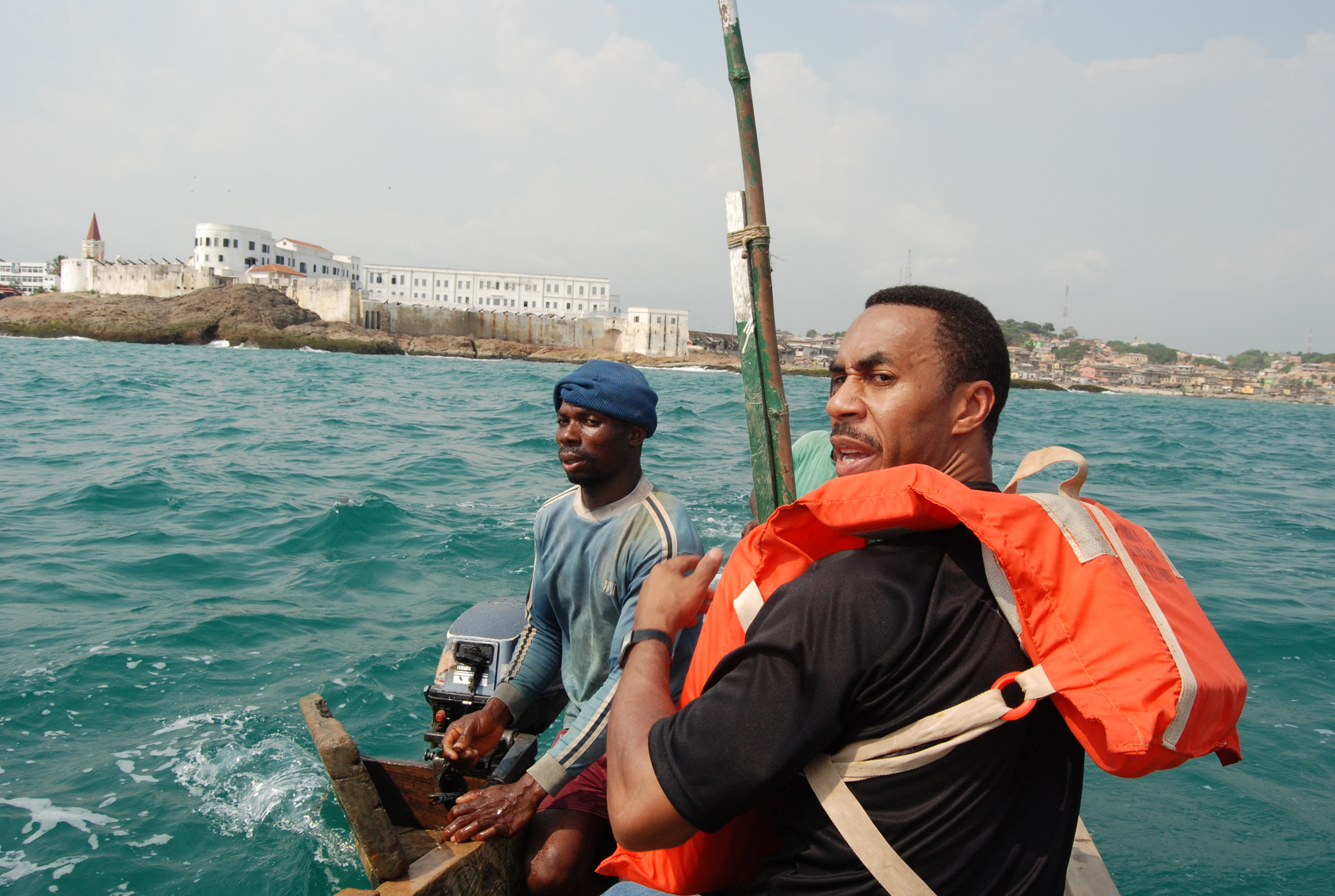
The journey continues! And what an extraordinary adventure for the trail blazing, award-winning Jamaican-born Hollywood stuntman/stunt coordinator Roy T. Anderson, when he flipped the script to direct his first feature-length documentary film, “Akwantu: The Journey” (105 min., 2011). Suddenly Anderson found himself behind the camera as the director/writer/producer of the highly anticipated film, which tells the story of his ancestors, the legendary Maroons of Jamaica, and their gallant fight for freedom.
“Akwantu: The Journey” is Anderson’s personal quest to document his Maroon lineage. The theme of the underdog rising up and succeeding drives this hallmarked story, which was shot in Jamaica, Ghana, Canada and the United States over the course of three years.
The powerful, milestone film takes Anderson, who was born in St. Elizabeth Parish, on what he calls “a most improbable journey” back to his roots, first to the secluded region of the Blue and John Crow mountains, where he meticulously delved into the history of Jamaica’s indomitable Maroon society and “the lives of a people whose enduring spirit of self- determination is as much alive today as it was more than 300 years ago.”
Anderson’s journey then crosses the Atlantic Ocean to Africa, focusing on Ghana (originally called the Gold Coast) and Cameroon. The Gold Coast was the homeland of many Akan-speaking people who, following their enslavement in the Caribbean region during the mid-18th century, would run away, leading to them being referred to as Maroons (derived from the Spanish word “cimarron,” defined as “wild, untamed and a general reference to livestock that has gone astray.”)
Here in the Motherland, according to Anderson, the film “retraces the steps of [his] ancestors and their agonizing trek on foot from Africa’s northern interior to the coastal dungeons of modern-day Ghana,” where the enslaved Africans “would be imprisoned while awaiting transport across the Atlantic,” an inhumane, brutal voyage that was referred to as the Middle Passage.
Riding alongside the history of the indomitable Maroons, Anderson simultaneously exposes his own personal trip from Jamaica, immigrating to Toronto, Canada, at age 11 and later to New Jersey as an adult. This life-changing North American landscape would bring him face to face with a phenomenal career as a stuntman and stunt coordinator in such blockbuster movies as “Shaft,” “Down to Earth,” “Spiderman 2,” “The Bourne Ultimatum” and “Hitch,” where he was the stunt double for superstar Will Smith.
For Anderson, this challenging, action-packed career was in no way coincidental. It was ordained. In essence, his lineage prepared him for it, knowing that it would take someone with the same type of “enduring spirit of self-determination,” courage and strength as his Maroon ancestors to break into the industry as a stuntman. However, Anderson not only excelled in his remarkable 25-year career, he set a world record that has yet to be broken for performing a self-planned stunt, jumping between two buildings 28 feet on foot (with no spring boards)-just run and jump.
This feat parallels the high Anderson felt when traveling back to the remote yet renowned Maroon community of Accompong in St. Elizabeth Parish to conduct his research for the film. There the filmmaker was provided with concrete information and documentation about the greatness of his Maroon ancestors and his own ancestry. After this trip, the framework for “Akwantu: The Journey” was conceived.
The breakthrough documentary features numerous interviews conducted by Anderson with world-renowned scholars, African nationals, Maroon officials and present-day Jamaican residents (both Maroon and non-Maroon). Anderson serves as the narrator of the film, which he shares is the story “of a people whose tale has not been told, has been undocumented, misunderstood or omitted” from the annals of history.
Through Anderson’s enlightening and important work, the world will learn of the Maroon rebellion and the brave warriors such as Captain Cudjoe and Granny Nanny who fought the powerful, colossal British Empire. The film also unearthed such important details as the First Maroon War (1720-1739), which resulted in the signing of two peace treaties with the British in 1739, establishing Maroon self-government on the Leeward and Windward parts of Jamaica.
According to Anderson, “Cudjoe and Nanny could be considered the Spartacus of their time,” except these enslaved Africans “were victorious in their fight for freedom,” a liberation “that the Maroons would come to embody both in mind and spirit while remembering their glorious though bloodied path to freedom.”
Anderson is one of the renowned descendants of this noble birthright. “As far back as I can remember, my family has always spoken proudly of our rich Maroon heritage,” he said. Through this life-changing odyssey, the Maroon spirit lives on in Anderson, who, in discussing “Akwantu: The Journey,” told a crowd in Charles Town, Jamaica: “This is personal to me. It’s the story of my ancestors, the Maroons and what they were able to achieve. It’s something we should be proud of-the world should know about it and it should be celebrated.”
This is one story that Caribbean Lingo! film will be following.
The Caribbean Lingo! series pays tribute to Caribbean Diaspora artists and art forms of the highest caliber.
