


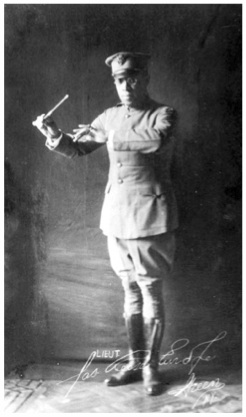
Today’s lesson takes a look at one of music’s greatest innovators, a man that famed composer Eubie Blake once called “Our benefactor and inspiration. Even more, he was the Martin Luther King of music.”
High praise for the man who bridged the gaps of race and culture with music done his way amid the turbulent backdrop of war.
James Reese Europe’s life began a long way from the French streets where he would enchant a nation. He was born in Mobile, Ala., on Feb. 22, 1882. His father, Henry Europe, moved the family to Washington, D.C., while James was still a youngster. “Little Jim,” as he was called, was taught to play the piano by his mother and later studied the violin.
After the death of his father in 1899, oup of musicians. Europe started to get paying work.
He became immersed in the thriving world of Black musical theater and began writing songs. In 1906, he composed “Gay Luneta” for Cole and Johnson’s “Shoe-Fly Regiment.” The following year, he composed the music for “The Black Politician.” In 1908, he became musical director for Cole and Johnson’s “The Red Moon” and contributed two compositions.
In 1910, Europe formed the Clef Club. This important musical organization served as a union and contracting agency for Black musicians. With some 200 members, it was the only such organization of its kind. The Clef Club, of course, had its own orchestra and chorus.
In 1912, the 200-piece Clef Club Symphony presented “A Concert of Negro Music” at Carnegie Hall. The program exclusively featured music written by Black composers and performed by Black musicians. Europe believed that while Black musicians respected their white counterparts, there was no need to imitate them. This orchestra was unique indeed, with 20 pianos, 60 guitars, 14 celli and 20 basses. The concert was a huge success.
In 1913, dances were the hot ticket on the New York social scene. Europe formed the Tempo Club, which booked Black musicians to play in house bands. In 1914, he partnered with Vernon and Irene Castle, inventing the turkey trot and foxtrot dances.
Europe’s talented band caught the ear of Philadelphia’s celebrated Wanamaker family, and Europe would perform at all family celebrations. Capt. John Wanamaker recalled his last serious talk with Europe, where he talked about leaving New York to go to World War I. “My country calls me and I must answer; and if I live to come back, I will startle the world with my music.”
He would, and he did.
Europe answered the call of war, taking his music with him. But his reluctant musicians did not want to go. They were doing just fine on the burgeoning jazz scene. Europe had 20 Black musicians who were the cream of the crop. He went to Puerto Rico and recruited 16 more, including Raphael Hernandez, who himself was one of the most prolific musicians of the time. These Black and Latino artists transcended language, culture and race, coming together to form an outstanding band of musical brothers who thrilled all who heard them.
The group, now known as the 369th Regiment, was ordered to France. They arrived on New Year’s Day 1918 and wasted no time dazzling the French with their brassy, sassy and completely unique sound. The band was sent out to perform at Army camps and in villages. French musicians tried reading the band’s charts and copying their sound but could not. American musicians contended that the instruments must be rigged. How did they get that sound? This made Europe’s band even more popular.
But the time to fight came on April 20, 1918. Europe and his men saw the first of 191 days of combat. By the war’s end, 171 men from the 369th Regiment were decorated for bravery, more than any other. The men were especially proud of the name the French gave them, “The Hell Fighters.”
On Feb. 17, 1919, the triumphant 369th Regiment returned to a hero’s welcome, marching along New York’s Fifth Avenue to Harlem to the cheers of frenzied crowds.
Europe and his Hell Fighters Band made 24 recordings and began touring the country promoting their music, which was a unique blend of jazz and ragtime unlike anything heard before or since. The 369th Infantry Jazz Band was now considered one of the world’s best.
“We won France,” Europe said, “by playing music which was ours and not a pale imitation of others. And if we are to develop in America, we must develop along our own lines.”
Europe had big plans for his music. He was on the brink of the great success he had always wanted, but after surviving the rigors of war, he would sadly meet his demise on American soil at the hands of one of his own.
On May 9, 1919, Europe was in Boston to lay a wreath at the base of the memorial for the 54th Massachusetts Volunteers, the first Black regiment to fight in the Civil War. But that evening, he was confronted by one of his musicians, a drummer named Herbert Wright. The drummer accused his boss of not treating him fairly. Without warning, Wright stabbed Europe in the neck with a penknife. Europe bled to death from his wound. He was just 39 years old and at the top of the emerging jazz scene.
The city of New York gave Europe an official funeral, the first ever given to a Black citizen. He was buried at Arlington National Cemetery.
Composer Noble Sissle said of his old friend, “In the death of Lt. Jim Europe, the world lost a genius and our race a most needed leader and benefactor.”
Activities
- Look it up: Use the Internet or other reference source to learn more about the life and music of James Reese Europe.
- Listen up: Check out the music of James Reese Europe on iTunes. Some of his notable recordings include “Castle House Rag,” “That Moaning Trombone” and “On Patrol in No Man’s Land.”
- Talk About It: James Reese Europe had great talent and great determination. Talk about how he found success despite the obstacles of racism and war.
This Week in Black History
- Sept. 10 – John Roy Lynch, speaker of the House in Mississippi and the first Black chairman of the Republican Convention, was born on this date in 1847.
- Sept. 13 – Alain LeRoy Locke, professor of philosophy and the first Black Rhodes Scholar (1908), was born in Philadelphia on this date in 1886.
- Sept. 14 – Constance Baker Motley, Manhattan borough president and the first Black woman appointed to a federal judgeship in the United States, was born in New Haven, Conn., on this date in 1921.
