


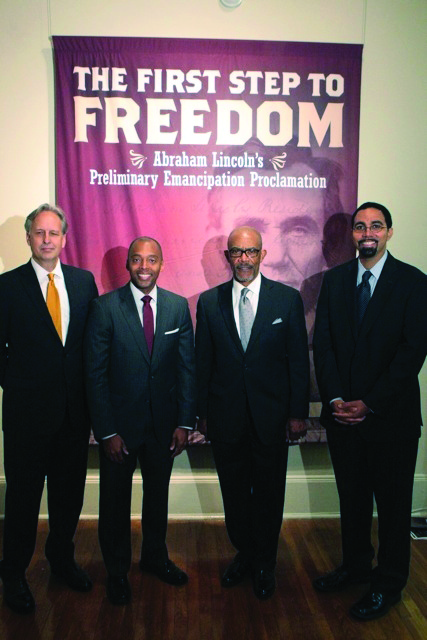
The Schomburg Center for Research in Black Culture celebrated the 150th anniversary of the preliminary Emancipation Proclamation by hosting a special exhibition Sept. 21-24. The exhibit featured President Abraham Lincoln’s handwritten preliminary Emancipation Proclamation and the official version of the document.
Contrary to popular belief, the Emancipation Proclamation did not free all the slaves in the United States–the document freed all the slaves in the rebel states. The Union had just won a critical battle against the Confederates at Antietam during the Civil War, and Lincoln took that opportunity to essentially deliver a death blow to the rebel forces. The Proclamation took effect in 1863. Complete emancipation came in 1865 with the passage of the 13th Amendment.
The Schomburg exhibit featured not only the two prized documents, but also information that traced the Black search for freedom in the U.S. from the early days of slavery to the Civil Rights Movement. Columns of information and photographs clearly explained the trials, tribulations and triumphs of the African-American quest for equality in terms simple enough for children to understand, but engaging enough for adults to enjoy.
Big names co-signed the exhibit. MSNBC host Melissa Harris-Perry and author Stephen L. Carter participated in a discussion about professor Carter’s historical novel “The Impeachment of Abraham Lincoln.” Actress S. Epatha Merkerson also stopped by for a discussion with Schomburg director Khalil Gibran Muhammad about the short film she produced, “The Contradictions of Fair Hope.” The film, which was shown on a rolling basis throughout the exhibit’s four days, tells the history of the Fair Hope Benevolent Society, which was founded right after Emancipation.
Also in the exhibit was a copy of the speech Dr. Martin Luther King Jr. gave in New York in 1962 to commemorate the 100th anniversary of the preliminary Emancipation Proclamation. The words of both Lincoln and King serve as testaments to the long and ongoing fight for true equality in the United States for African-Americans.
