


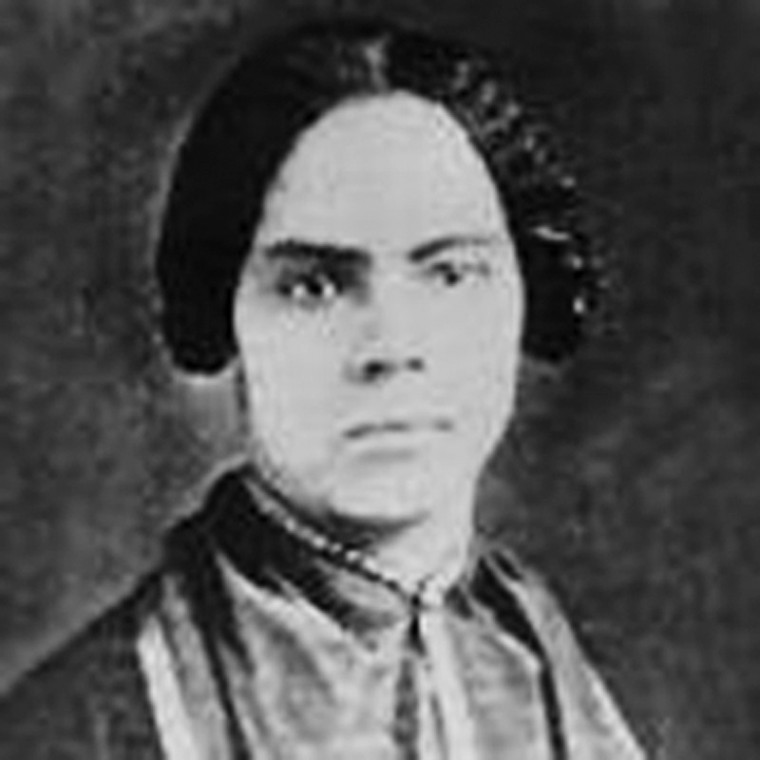
Known as “The Rebel,” she became a champion of the anti-slavery movement and the first Black female publisher and editor of a newspaper in North America.
On Oct. 9, 1823, Harriet and Abraham Shadd welcomed the first of their 13 children into the world, a daughter they named Mary Ann. The family lived in Wilmington, Del., where the Shadds were already established as leaders in the Black community. Abraham Shadd was a key figure in the Underground Railroad, with his home being a stop. He was also a subscription agent for William Lloyd Garrison’s newspaper, The Liberator. A dedication to fighting for Black freedom was already in young Mary Ann Shadd’s blood.
When Mary Ann Shadd was 10 years old, the family moved to West Chester, Pa., where for the next six years she attended a Quaker school. The experience left a lasting impression on the young girl about the importance of education, especially for Black children. She would return in 1840 and open a school of her own.
Shadd was a gifted and eloquent writer. In 1849, she published an essay titled “Hints to the Colored People of the North.” She also penned a letter to Frederick Douglass’ North Star newspaper. She spoke out against those who took advantage of freed slaves and criticized the Black Southern Ministry for not promoting education, self-reliance and personal growth to their congregations.
The Fugitive Slave Law of 1850 stymied the progress of free Blacks by putting a bounty on their heads. There was much traffic on the Underground Railroad as thousands of free and enslaved Blacks set their sights on Canada, where slavery had been abolished in 1833.
In 1852, Shadd wrote “A Plea for Emigration,” in which she urged Black Americans to free themselves from American racism by emigrating to Canada. She decided to take her own advice, and, with her brother Isaac, headed to Canada, where she quickly got to work and started an integrated school.
By 1852, there were some 30,000 free Blacks living in Canada, with 5,000 to 6,000 new emigrants arriving each year. These new residents needed information and a voice, and, for the next four years, that voice was The Provincial Freeman.
The Provincial Freeman, a weekly publication devoted to anti-slavery, temperance and general literature, began publication on March 24, 1853. With its focus on support of the anti-slavery movement, equality and self-education for Canadian Blacks and those living in the United States, it was a bold and aggressive read with a downright militant editorial policy, while, at the same time, delivering valuable news and information to the community such as church and business activity.
The paper was quite clear on its intent to represent and promote the interests of its Black readers. Unlike other such publications at the time, the editor and board of directors were all Black. Shadd would take on publishing and even investigative reporting duties. Shadd and the Rev. Samuel A. Ward shared the editing duties. With this, Shadd became the first Black woman to publish and edit a newspaper in North America and the first ever to do so in Canada.
In 1856, Shadd married Thomas F. Cary of Toronto. The couple had two children, Sarah and Linton. The family lived in Chatham, where Mary worked at her paper and taught school. Thomas Cary died in 1860.
The Provincial Freeman suspended operations for a time but was revived with relocated offices. Publication continued for the next few years until the paper became beset with financial problems and was forced to close for good with issue No. 49, on Aug. 22, 1857.
In 1858, famed abolitionist John Brown held a secret convention at the home of Shadd’s brother Isaac, which raised her concerns for the anti-slavery movement. In 1861, she published “Voice From Harper’s Ferry” in tribute to Brown’s ill-fated raid.
After the folding of her newspaper and the death of her husband, Shadd returned to the United States with her children, settling in Washington, D.C. She began recruiting Black officers for the Union Army. She continued to promote Black Nationalism and educate Black children.
In 1869, when her youngest child was 9 years old, she enrolled at Howard University Law School. After 13 years of teaching school in the day and attending classes at night, at age 60, she became the nation’s second Black female to earn a law degree, graduating in 1870.
Shadd continued to lecture and write for other newspapers. She joined the National Women’s Suffrage Association, working with Susan B. Anthony and Elizabeth Cady Stanton. She testified before the Judiciary Committee of the House of Representatives and became the first Black woman to cast a vote in a national election.
The remarkable pioneer died in Washington, D.C., on June 5, 1893, after suffering with stomach cancer. Her daughter, Sarah, was still living. Her son, Linton, had died the previous year. Her obituary described her as “a woman of excellent traits of character and loved by all who knew her.”
The Mary Ann Shadd Cary House, located at 1421 W Street in Washington, D.C., was declared a National Historic Landmark in 1976. Shadd Cary was also honored in Canada with the designation of a “Person of National Historic Significance.”
Activities
- Look It Up: Use the Internet and other reference sources to learn more about the life and work of Mary Ann Shadd Cary. Discover more about the events detailed in “This Week in Black History.” Discuss these events with your classmates.
- Talk About It: Check out the website listed below and read articles that appeared in The Provincial Freeman. Break up into groups to read and discuss each one. To see select articles from The Provincial Freeman, go to http://utc.iath.virgini
- Write It Down: Write an article that you would have liked to see in The Provincial Freeman. Remember to relate your article to what was happening in Black America at the time.
This Week in Black History
- Oct. 22, 1906: Three thousand Blacks demonstrated and rioted against a theatrical presentation of Thomas Dixon’s controversial novel “The Clansman.”
- Oct. 25, 1958: Ten thousand students, led by labor leader A. Phillip Randolph, actor and activist Harry Belafonte and baseball great Jackie Robinson, converged on Washington, marching from Constitution Avenue to the Lincoln Memorial in the 1958 Youth March for Integrated Schools.
- Oct. 28, 1798: Levi Coffin, the founder of the Underground Railroad, is born.
