


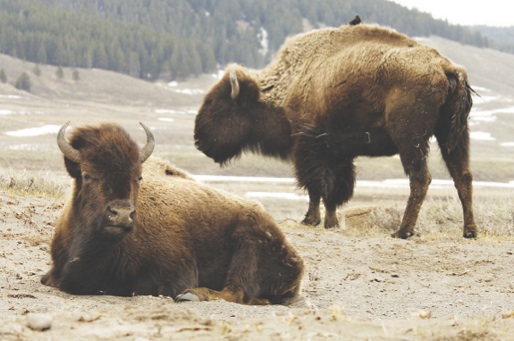
Nov. 1 was National Bison Day!
The bison has been honored with a place on the defunct Buffalo nickel. It also appears on the state flags of Wyoming and Kansas, both of which, along with Oklahoma, have adopted it as their state mammal. Now there’s a campaign under way to make the bison America’s National Mammal.
The American bison is commonly known as the American buffalo. These animals once dominated the plains and grasslands of North America, from Canada’s Great Bear Lake to the Mexican states of Durango and Nuevo Leon. With few predators large enough to challenge them, their herds once numbered in the millions. The bison is a member of the bovine family and is the largest land mammal in North America.
What’s in a name?
The word “bison” is a Greek word meaning an ox-like animal. It is believed that the word “bison” originated with French fur trappers who called them “boeufs,” meaning ox or bullock. The Lakota called them “tahtanka,” which also means bull. Bison are commonly referred to as buffalo, but they are, in fact, just a distant relative to the “true” buffalo species, the Asian water buffalo and the African buffalo. The American bison is distinguished from the buffalo by its thick winter coat and large hump. They are more closely related to the European bison.
There are five types of bison. The Plains bison and wood bison are both subspecies of the American bison that we know. Also in the family are the Wisent (European Bison), Cape buffalo, (found in Africa) and Asian water buffalo.
Though bison are also related to the domestic cow, there is nothing domestic about them. Native people never tried to tame them, and Europeans who tried had no luck. These animals, while routinely docile, have a wild side when agitated. They can jump as high as 6 feet straight up.
The bison has a shaggy, wooly coat that turns dark brown in the winter and light brown in the warmer months. They can stand more than 6 feet tall and can range in weight from 700 to well over 2,000 pounds. But despite their bulk, they are quick and agile and can run at speeds of up to 35 miles per hour.
Both males and females have short, curved horns that can grow up to 2 feet. These are used for fighting for territory and mating rights, though few battles are fought to the death.
These massive animals are herbivores, meaning that they eat only plants–and lots of them, all day long. Bison will typically graze (eat grass) in two-hour sessions, rest and chew cud (regurgitated grass), before moving on to a new section to start all over again.
Just like their more common bovine kin, males are called bulls and females are called cows. Mating takes place in August and September, with pregnancy lasting for nine months. The baby calves are usually a reddish-brown color and will nurse for up to 18 months or until the mother has another calf.
In very rare instances, a calf is born completely white. These special white buffalo calves are considered sacred by Native Americans. They symbolize rebirth and reconnection with the spirit. Only one in 10 million calves are born white.
Bison herds consist primarily of cows and calves. Bulls are solitary animals, joining the herd during mating season, which is called “the rut.” At three years, the young bison are ready to start families of their own. However, bulls must wait their turn and have to compete with the older, stronger bulls.
Bison numbers were once as high as 60 million. But greedy European fur traders, the advance of Western settlers and a need by the American government to destroy the lifestyle of indigenous people would drive them to near extinction in a short span of time. Railroads even allowed tourists to shoot them from trains for sport.
Millions of bison were killed and along with them, a traditional way of life for native people, who depended on the animal for everything from food, clothing, tools and even the homes in which they lived. The horns were used as spoons or scoops. The heart was used as a sack. The stomach could actually be used as a cooking vessel. The hides were used as insulating walls in teepees and to make shoes and shields. Nothing went to waste.
Preparing the animal after a kill was a two-part job. The first part was butchering and removing the hide. The meat was cut into long thin strips and dried in the sun. This meat was easy to carry and perfectly preserved. Next was dressing the hide. First, the wet hide was stretched out tight and pegged to the ground. Next, the remaining flesh was scraped from the hide, and it was shaved down to an even thickness. The hide was then tanned and softened. It could be used for clothing. Hides with hair on them were used as blankets or coats.
As the demand for trading hides grew, the natives were only using about one of every 100 bison they killed. The American Fur Company bought an estimated 112,000 buffalo robes during a two-year span, representing a staggering amount of labor for hide workers. During the height of the slaughter, millions of animals were killed and their carcasses left to rot until there were less than 1,000 left in the wild.
In 1881, during the last bison hunts, Pete Dupree and his wife, Mary Good Elk Woman, captured six bison calves and took them to their home on the Cheyenne River Indian Reservation and started a herd. Thirty-six of them were sold to the state of South Dakota to begin the Custer State Park herd. Other small herds were started, and slowly but surely, the bison began to come back. Wild bison herds are found in national parks and refuges in just six states–Montana, Wyoming, Iowa, Nebraska, South Dakota and North Dakota–and in one Canadian province.
Though these great mammals no longer dominate the Plains, their escape from extinction is one of conservation’s great success stories.
Activities
- Look It Up: Use the Internet or other reference source to learn more about the North American bison.
- Talk About It: Why is the bison such an important part of American history? Can you think of another animal that has played an important role in history? Should that animal also be honored? Why or why not?
- Find It: Use a map or globe to locate places in our country and around the world where bison or buffalo can be found.
- Cast Your Vote: The Wildlife Conservation Society and the Bronx Zoo is helping to make the bison our National Mammal. New York’s own Sen. Chuck Schumer has co-sponsored S. 3248, the National Bison Legacy Act, which would designate the North American bison as the National Mammal of the United States. To cast your vote, go to www.votebison.org.
