

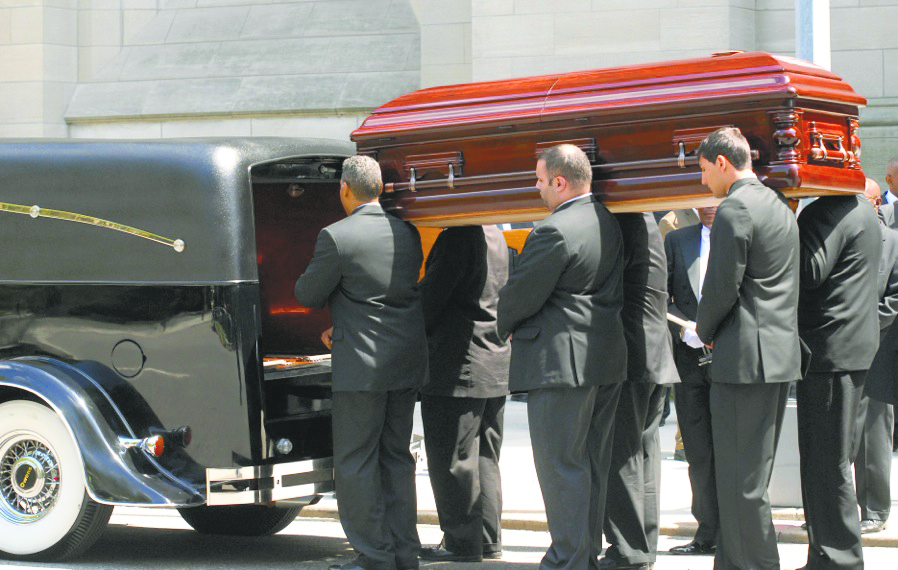

Delivering the eulogy for Bill Lynch Jr. at Riverside Church last Thursday, the Rev. Michael Waldron of First Corinthian Baptist Church said there were no words to capture the great man’s majesty, but the good reverend came close. “Bill Lynch was a transcendent soul,” Waldron told the overflow crowd, which included the rich and the poor. “He was a mighty river pouring into others … so self-effacing that you were embarrassed to be arrogant.”
Waldron conjured up mythic and biblical metaphors as he evoked the memory of a man who shunned the spotlight, content to be an adviser—a wise counsel behind the scenes.
“And without Bill Lynch, none of us would be here,” the Rev. Al Sharpton said, after noting the presence of “President Clinton and her husband, Bill.” “He was the glue that held us together. He taught us how to get things done.”
Getting things done was uppermost on Lynch’s agenda; he joined the ancestors on Aug. 9 from kidney disease. He was 72.
In the VIP section of the church was a host of politicians and civic leaders who had benefited from Lynch’s political acumen, including the Clintons, Rep. Charles Rangel, David and Basil Paterson, Elinor Tatum, Ben Jealous, Hazel Dukes, Council Member Inez Dickens, Bill Thompson and, most notably, David Dinkins.
“He was the greatest man I’ve ever known,” said Dinkins, recalling how significant Lynch was in guiding his campaign to become New York City’s first Black mayor. “He was driven by ideals, fairness; he was a loving husband, a devoted father, a man of character.”
Lynch’s daughter Stacy, an attorney, reminded the audience how her father was often referred to as the “rumpled genius,” indicating his disregard for sartorial splendor. “That’s one of the things they called him, but to me, he was just Dad, and he showed me I could be anything I wanted to be.”
Stacy’s brother Bill Lynch III said, “If I can be half the father he was to me, I’ll be all right.”
During her moment at the podium, Hillary Clinton touched on Lynch’s gravelly voice, which was always “full of concern and insight.” “I saw him at his best as a trusted adviser,” she continued. “He was a numbers guy before computers and always ahead of the curve.”
Bill Clinton said that one look in Lynch’s eyes told him all he needed to know about the man’s way of taking things in. “‘You don’t have to perfect, but you have to deliver,’ he once told me.” Clinton had anticipated what Lynch’s lifelong friend Floyd Harris had to say about Lynch, who “always had a plan to make it happen.”
Newly appointed South African ambassador Patrick Gaspard, who once worked under Lynch, recalled his mentor and his devotion to teaching the young people who came under his tutelage. “Sometimes folks would ask him how he was able to bring about a political victory, and he would say, ‘I was hoping you would tell me,’” said Gaspard. His presence symbolized the role Lynch played in Nelson Mandela’s victorious presidential campaign in 1994.
Lynch would have loved the rendition of “Amazing Grace” performed by trumpeter Wynton Marsalis and his ensemble. It had a traditional New Orleans touch to it with a hymnal beginning that gradually morphed into a “didn’t he ramble” second line romp as they marched out of the sanctuary. There was no marching down the aisle for the Ebony Ecumenical Choir, but they did walk to the stage for two songs, and “I Don’t Feel Noways Tired” was more than appropriate for the tireless Lynch.
Equally uplifting was Donnie McClurkin’s always rewarding treatment of “Stand,” which brought many folks to their feet, as they all did when commanded by the Rev. Jesse Jackson. “Give Bill Lynch a round of applause,” he said. “Bill was a compassionate man who did his best work when no one was looking.”
“He knew what buttons to push to bring about solutions,” said Rangel. “And even more, he allowed people to think.”
Like the Revs. Stephen Phelps, Linda Tarry-Chard and Dr. James Forbes, Basil Paterson extended his thanks to the family, “particularly to Mary,” Lynch’s widow, “for sharing Bill with us for so many years.”
The NAACP’s venerable leader Hazel Dukes recounted her days with Lynch in Nassau County and later as a supporter of her organization. “Words cannot convey the respect I had for him,” she said.
Nor could Local 1199 leader George Gresham help but extend his appreciation for Lynch when he summoned a contingent of rank-and-file members to join him on the stage with signs that read, “Thank you, Bill.”
“I often asked Bill why he chose to sit in the back of the room all the time,” said Leonard Riggio, his friend and partner in a non-denominational church they founded. “‘I can see everything from the back,’ he said.”
And perhaps he could see all of this looking down.