


As the Amsterdam News went to press Wednesday, it was announced that the city will begin security camera installation at Boulevard Houses and five more housing developments around Brooklyn, Manhattan, the Bronx and Queens.
Standing with City Comptroller Scott Stringer, alongside New York City Housing Authority chair Shola Olatoye, City Councilmember Inez Barron and public housing residents in East New York, Mayor Bill de Blasio stated that in the wake of the tragic stabbing death of 6-year-old Prince Joshua Avitto, he would review the steps required to approve funds for camera installations and expedite the process to complete the installation of cameras at 49 developments before the end of 2014.
“The installation work that begins today is the result of a highly collaborative process among City Hall, NYCHA and the comptroller’s office,” said the mayor. “It comes to show that when there is a will, there is a way. The safety and security of families living in public housing is a priority for my administration, and we will continue to work to find ways to give NYCHA residents the quality of life they deserve.”
Brooklyn Borough President Eric L. Adams said, “I appreciate that the de Blasio administration has stepped up to show leadership for the future of our residents in public housing. For years, NYCHA has fallen short of its commitment to its tenants, leaving too many in unsafe and unhealthy conditions. The installation of security cameras at Boulevard Houses, just a week after the fatal stabbing of Prince, is far more than a symbolic act. In fact, the approval of over 90 security camera contracts in less than a week shows the City’s commitment to safety. We need to approach other issues facing NYCHA developments with the same energy, urgency and expediency.”
“I want to thank Mayor de Blasio for prioritizing the expansion of cameras at NYCHA housing throughout the five boroughs,” said Stringer. “My office worked hand-in-hand with the administration to ensure that this process moved forward without further delay. The more than 400,000 New Yorkers who call NYCHA home deserve to feel safe. This is a step in the right direction, and I look forward to continuing to work with the mayor, my colleagues in government and NYCHA residents to improve public safety and quality of life in their communities.”
“We are committed to doing things differently, resetting our relationships and becoming a more transparent, next generation NYCHA,” said Olatoye. “As we move forward now to install these cameras with a more efficient and timelier public process, thanks to Mayor de Blasio and Comptroller Stringer, as well as our own revised capital programs, we’re able to do even more for our residents. And that’s what matters most.”
“Security cameras are a common sense solution to enhance security and keep the 600,000 New Yorkers who live in public housing safe,” said City Council Speaker Melissa Mark-Viverito. “I thank the de Blasio administration and Comptroller Stringer for their swift action to expedite camera installations at Boulevard Houses and dozens of housing developments across the city and applaud my colleagues in government for working together to improve quality of life for NYCHA residents.”
The work began immediately, with 17 cameras going to nine Boulevard Houses buildings.
Following the stabbing deaths of Prince and 18-year-old Tanaya Copeland of East New York, along with 7-year-old Mikayla Caper recuperating from stabbing injuries, tempers continue to flare. Residents are arguing, “Why doesn’t the city ensure the community will be safe and that [the people are stable enough] to be housed in homeless shelters, before they put them there?”
“They’re just popping up all over the place, and our kids are not safe,” said Cathleen Freemantle, who has been living in East New York for more than 40 years. “I have to chase them [homeless men] from underneath my window at times. They often sit there and smoke. Something needs to be done about this.”
Freemantle’s sentiments were echoed over and over by angry residents at a recent town hall in East New York. Residents complained that there are five homeless shelters in the East New York community, and homeless people like Daniel St. Hubert roam the streets day and night. St. Hubert was arrested in connection to the recent stabbings and is suspected of being mentally ill.
Residents believe the community is not safe for children and those coming home late at night from work. “Who is in charge of the shelters? Do the homeless men have curfew hours?” one man asked. But it was a question that neither the NYPD, New York City Housing Authority or local elected officials answered.
City Councilwoman Inez Barron, who represents the district, stated that the shelters are “privately owned and operated.”
When one resident asked “why the city has allowed them [the private company] the open a shelter in the community,” Barron answered, “The city cannot stop them from opening a homeless shelter.” She said that before the shelters were open, the matter was first discussed at community board meetings.
Some residents said they’re not against private companies opening shelters in the community, but that there needs to be a better security system so residents, especially children, are not in harm’s way.
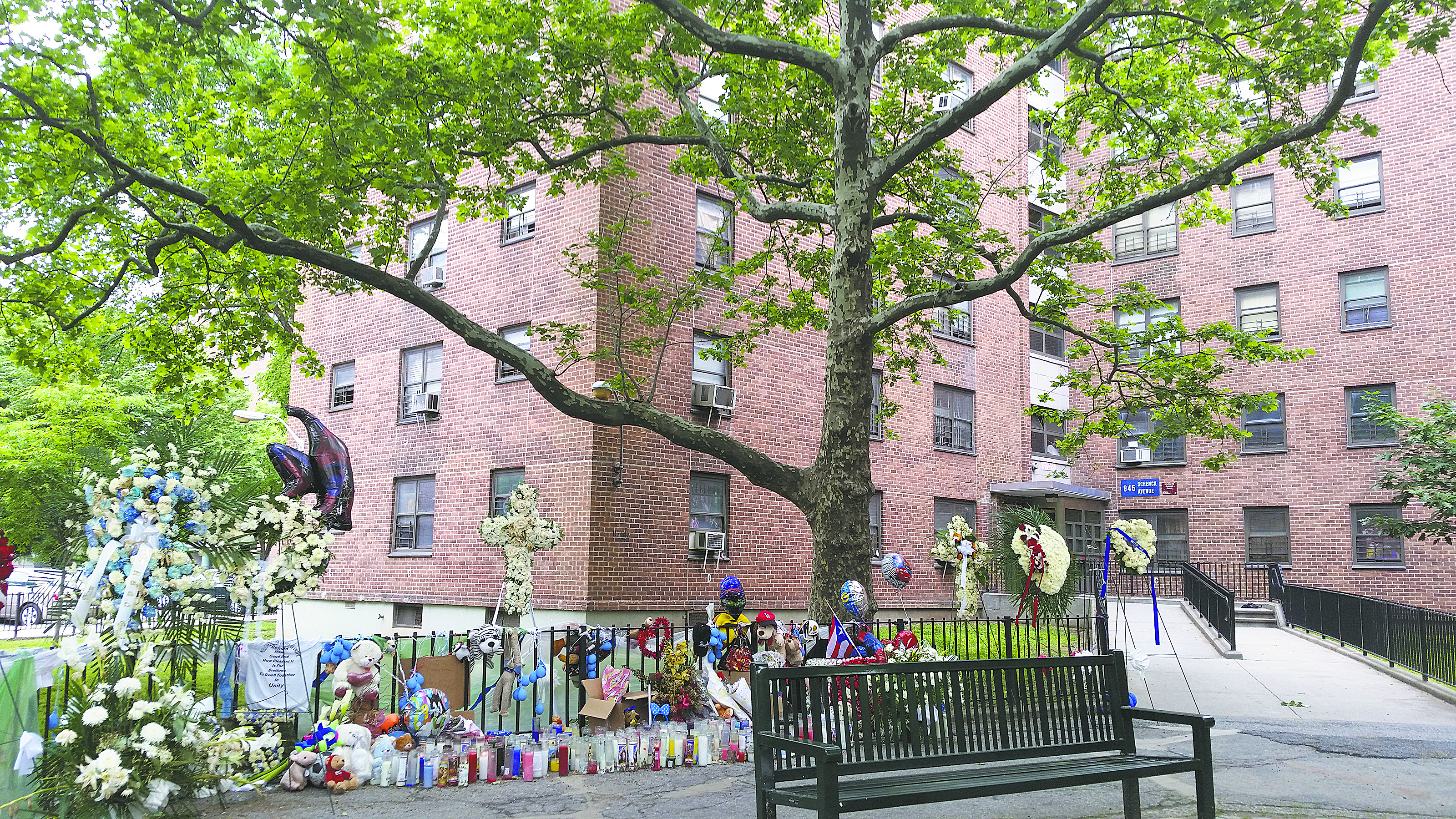
In the packed auditorium of mostly youths and children at the George Gershwin School on Van Siclen Avenue, there were also more questions than answers as to why there are only five cameras in 18 buildings that make up Boulevard Houses, the apartment complex where Avitto and Caper were stabbed. The complex has 1,436 apartments and houses more then 3,000 residents, according to NYCHA’s website. Residents said the incident has proven that they’re “desperately in need of more cameras.”
As of press time their requests were granted.
Chair of the City Council’s Public Housing Committee Ritchie Torres had recently sent a letter to the mayor, arguing, “It should not take the brutal stabbing of a 6-year-old little boy and a 7-year-old little girl to compel the city to implement common sense safety measures like the installation of surveillance cameras and secure entryways in our public housing developments.”
