


Situated along California’s Central Coast region just 249 miles north of Santa Barbara, five miles south of Monterey and about 120 miles south of San Francisco, Carmel is a spectacular vacation gem. Its boutique size—just one incorporated square-mile within the larger Monterey County boundaries with only 3,900 full-time residents—is part of its charm and what has attracted people here for decades.
Its history dates back to the early 1700s, when the San Carlos Borromeo de Carmelo Mission was founded by one of several Spanish Franciscan monks, who eventually had 21 missions built throughout California. It remains today a historic National Historic Landmark Basilica Church, school and museum.
The waterways, fertile soil, topography and weather were among the many factors that attracted numerous early explorers to the area to establish businesses, agriculture and other entities. This included two businessmen who founded the Carmel Development Company in the 1900s, which helped transform Carmel into a true village.
You could say that the decades to follow really “made Carmel’s day”—yes, that’s my cheeky ode to actor and director Clint Eastwood’s famous “Dirty Harry” “make my day” movie lines. Eastwood was elected mayor of Carmel in 1980. As a longtime resident, Eastwood and other celebs who both lived and vacationed here raised Carmel’s visibility and popularity. Since that time, folks have flocked here from all over the world to enjoy this unique setting that captivates and inspires the senses.
A great place to start your exploration of Carmel-by-the-Sea (which, although part of the bigger Carmel area, is still commonly referred to as “Carmel”) is to stop by the Carmel Visitor Center, which is chock full of information, brochures, maps and other items to help visitors plan their stay here.
For an overview of Carmel’s history and historic structures, begin with one of the first, the First Murphy House. Constructed in 1902, it is named after Carmel’s most prolific designer and builder, Michael J. Murphy, and is now the home of the Carmel Heritage Society, offering a wealth of historic exhibits, written documents and audiovisual elements about the area’s history.
Murphy went on to design and/or build over 300 homes and buildings in Carmel, many of which are highlighted along the “Carmel History Tour.” On it, visitors can learn about and explore places such as the Harrison Memorial Library, designed by well-known architect Bernard Maybeck; the Golden Bough Theater, now home of the Pac Rep Theatre, the only professional theater on the Monterey Peninsula; and the Cypress Inn, a landmark, Mediterranean-style boutique hotel built in 1929—it was originally called La Ribera—and today co-owned by actress Doris Day.
Other historic entities include one of the city’s original fire stations, built in 1937 of Carmel stone, the Seven Arts Building and Court, built in the late 1920s for Herbert Heron, and the Forest Theater, a 540-seat amphitheater established in 1910 as the first outdoor theater west of the Mississippi, just to name a few.
CARMEL-BY-THE-SEA TODAY
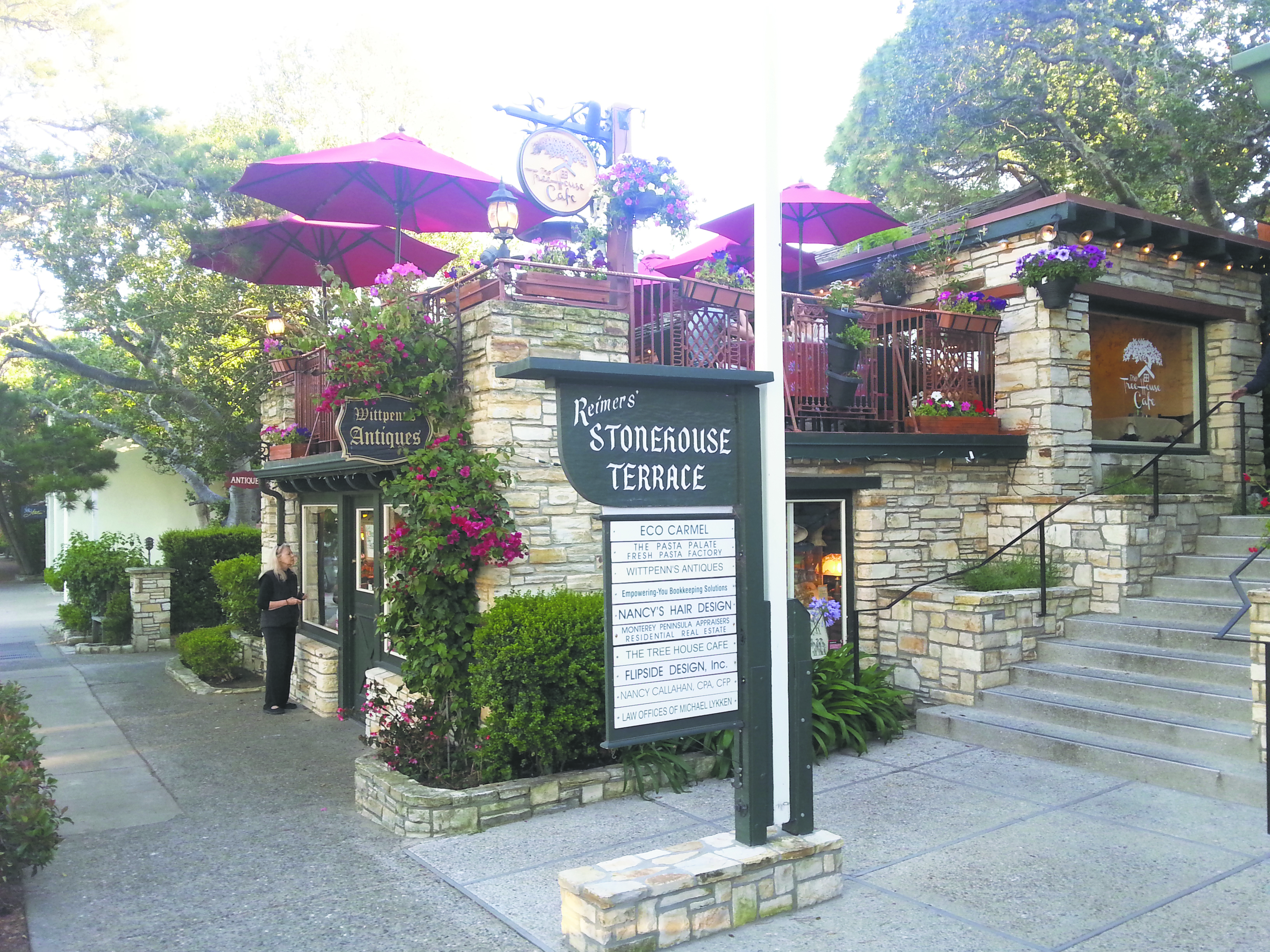
Today, Carmel-by-the-Sea is consistently rated as a top U.S. 10 destination by many A-list travel, lifestyle, arts and culinary websites and publications, each invariably noting how its fascinating history, expressive architecture, unique topography, beautiful weather, captivating charm and romance, and intimate size create a unique backdrop for its plethora of bistros and restaurants, cultural and performing arts, art galleries, shops, accommodations and more.
Its unspoiled beauty is both natural and by design, as the city has gone to great lengths to preserve, protect, promote and integrate eco-friendly and green practices into nearly every aspect of daily living, working and tourism here.
For example, the city discourages use of cars, instead promoting “pedal power” as a means to get around the city, including a Helmet Thursday program, providing discounts to cyclists who bring in their helmet, coupled with eco-friendly educational tips on sustainable living and discounts.
Those with electric or hybrid vehicles can take advantage of a free charging station, while gas-powered tools, such as lawn mowers and leaf blowers, have been banned.
One of the earliest laws on the books, although not really enforced now, is the prohibition of wearing high heels over two inches (I know, what?!), a throwback to the 1920s when there was a push to protect the city from irregular pavement tripping accident lawsuits on their hilly, tree-root bound streets. But who’d want to wear them along these steep, albeit beautiful streets anyway?
And then there’s this cool “no street addresses” thing, the city still holding to its early founders’ use of a central post office and no addresses for homes or businesses. Wanna find “ABC Gallery”? A resident will tell you, “Go down two blocks to the bank on the southwest corner, turn left, up three houses to the beautiful peach cottage with the colorful, hand-painted mailbox, hang a right to…”—you get the gist!
Other ordinances include banned street lights—yep, still none, along with no sidewalks or parking meters outside of the downtown commercial area—and a prohibition on selling and eating ice cream on public streets. You can do that now though! And my favorites, no chain stores or restaurants and strict rules on signage size and styles. Both, in my humble opinion, would greatly detract from the Central Coast escape ambiance here and make Carmel too commercial like, unfortunately, many other small tourist towns across the country.
Unique as some of these aspects may seem, they all work and are part of the charm that draws you in the moment you arrive. We’ve got lots more about Carmel-by-the-Sea coming up!
Lysa Allman Baldwin is a freelance writer and the publisher and editor of Amazing Escapades, offering “adventures for the mind, bod and belly” (www.amazingescapades.com).
*REFERENCE LIST
Carmel Heritage Society
831-624-4447, www.carmelheritage.org
Carmel History Tour
831-204-2010, www.carmelhistorytour.com
Carmel Visitor Center
800-550-4333, www.carmelcalifornia.com
Cypress Inn
831-624-3871, www.cypress-inn.com
Forest Theater
866-622-0709, www.foresttheatercarmel.org
Harrison Memorial Library
831-624-4629, www.hm-lib.org
Pac Rep Theatre
831-622-0100, www.pacrep.org
San Carlos Borromeo de Carmelo Mission
831-624-1271, www.carmelmission.org
