


Bobby Hutcherson, who changed the vernacular of jazz vibraphone and influenced generations of aspiring musicians in the process died Aug. 15 at his home in Montrara, Ca. He was 75.
The cause was complications related to emphysema, longtime family friend Marshall Lamm told The Associated Press.
Whereas earlier vibraphonists such as Lionel Hampton used only two mallets, Hutcherson’s sound included a pair of mallets in each hand. His free, graceful flow was similar to the enthusiastic hand motions of Gerald Wilson conducting any number of dynamic musicians.
In 2004, Hutcherson became an inaugural member of the SFJAZZ Collective (a collaborative reparatory that created new music), featuring Joshua Redman, Miguel Zenón, Nicholas Payton, Renee Rosnes and Eric Harland. He toured with them for four years.
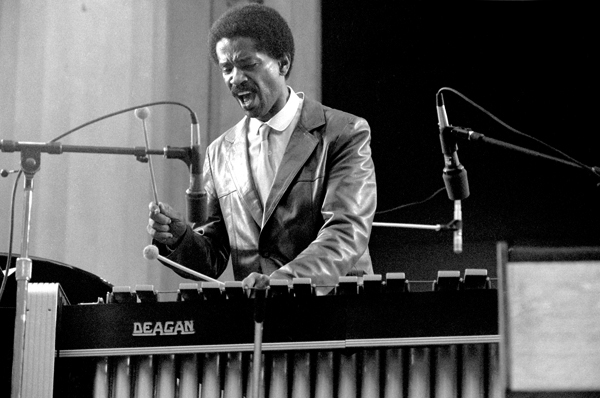

In 2010, he was named a jazz master by the National Endowment for the Arts. In 2014, he returned to Blue Note Records with “Enjoy the View,” with Joey DeFrancesco, David Sanborn and Billy Hart.
He released more than 40 albums and appeared on the now classic albums such as “Out to Lunch,” by the alto saxophonist and multi-instrumentalist Eric Dolphy, “Mode for Joe,” by the tenor saxophonist Joe Henderson, “One Step Beyond,” by alto saxophonist Jackie McLean and “Idle Moments,” by guitarist Grant Green.
These albums were a result of Hutcherson’s affiliation with Blue Note Records (1963 to 1977), which began after the trombonist Grachan Moncur III heard him playing at Herbie Lewis’ jam session and introduced him to his bandleader and Blue Note artist Jackie McLean. After their first recording, Hutcherson became a regular session player who filled the bill from hard-bop to avant-garde. He was engrossed in the blues on “Idle Moments.”
Several of his compositions, particularly the ballads “Little B’s Poem” (written for his son Barry) from the 1965 album “Components” and “Summer Nights” from the 1966 album “Stick-Up!” (featuring Joe Henderson, Herbie Lewis, pianist McCoy Tyner and drummer Billy Higgins), have become jazz standards.
“He came along and totally changed the way most people were used to hearing the vibes,” said Warren Wolf, young vibraphonist influenced by Hutcherson. “He brought an avant-garde technique to the instrument, and he kind of played the vibes like how a horn player would normally play. So he was just a natural wonder.”
Robert Hutcherson was born in Los Angeles Jan. 17, 1941. His father, Eli, was a brick mason, and his mother, Esther, was a hairdresser. While growing up in Pasadena, he became interested in jazz through his older brother Teddy, who attended school with Dexter Gordon, and his sister Peggy, who sang with the Gerald Wilson Orchestra and later joined Ray Charles as a Raelette.
Hutcherson took piano lessons as a child but changed his tune upon walking past a record shop and hearing a recording of vibraphonist Milt Jackson. He eventually earned enough money to purchase a vibraphone by working with his father.
His good friend Herbie Lewis hired him to perform with his band. In 1962, Hutcherson joined the band of Count Basie alumni tenor saxophonist Billy Mitchell and trombonist Al Grey, which took him to New York City for a debut engagement at Birdland jazz club.
In his 2009 NEA interview, Hutcherson recalled his first appearance at Birdland. The club’s master of ceremonies, Pee Wee Marquette, knocked on the dressing room door.
“I opened the door,” said Hutcherson. “And he had this big cigar in his mouth and he blew a bunch of smoke in my face and said, ‘Hey Papa, you got something for me?’ And I knew he was waiting for some money, so I said, ‘Are you kidding?’” That night, Marquette deliberately tangled Hutcherson’s name, introducing him as “Bubba Hutchkins on vibes.”
The next night, when Marquette came around, Hutcherson’s bandleader Al Grey said, “Give him $5. You’ll see the difference.”
“So I hand him $5,” said Hutcherson. “Pee Wee said, ‘Thank you Papa and slams the door and walks off.’” The next night Marquette got his name right. “See what $5 does?” Grey told Hutcherson. “Now everybody knows what your name is.”
The group broke up soon afterward, but Hutcherson remained in New York driving a cab. While living in the Bronx he married his high school sweetheart, the former Beth Buford.
However, he was arrested in 1967 on marijuana possession in New York City and lost his cabaret card, his permit to perform in the city’s clubs. He moved back to California and later to the San Francisco area. He bonded with the tenor saxophonist Harold Land and the pianist McCoy, which led to a series of Blue Note albums.
In the height of the Civil Rights Movement, many jazz musicians took a stance with such albums as “Freedom Now Suite!” by Max Roach and “The Prisoner,” by Herbie Hancock. Hutcherson took his stance with “NOW!” featuring Harold Land, drummer Joe Chambers, bassist Lewis, pianists Kenny Barron and Stanley Cowell, percussionist Candido and vocals by Gene McDaniels.
After his stellar run at Blue Note, Hutcherson recorded for the labels Columbia Records, Landmark and Kind of Blue. Land and Hutcherson reunited in the early 1980s for several recordings as the Timeless All Stars, for the Dutch label Timeless Records.
Hutcherson appeared in the 1986 Bertrand Tavernier film “Round Midnight” with Dexter Gordon and pianist Herbie Hancock and as the bandleader in “They Shoot Horses Don’t They?” (1969).
“You don’t play this music to get rich,” he told the website AllAboutJazz.com “You play it for the thrill of playing another note. And after that note, the next note and after that, the next. “
Hutcherson’s survivors include his wife of 44 years, Rosemary; a son from his first marriage, drummer Barry Hutcherson; a son from his second marriage, Teddy Hutcherson; and two grandchildren.
