


Dick Gregory possessed a comedic gift that when combined with his political insight cut like a laser to the heart of the Black experience in America. In one skit, and sometimes in one line, he could encapsulate the absurdity of race relations in the nation, often offering a biting, sardonic African-American response. We will miss his genius, his tart tongue and his way of telling white America about the essence of Black humanity. Gregory, 84, joined the ancestors of apparent heart failure Saturday in Washington, D.C.
In a chapter of his first book, “Nigger,” an autobiography he did with Robert Lipsyte in 1964, Gregory recounts a performance at the Playboy Club in Chicago in 1961, which propelled his remarkable career. Hired to fill in for the comedian Professor Irwin Corey, he stood before an audience of white Southerners and after greeting them said he knew the South very well. “I spent 20 years there one night,” he cracked.
He told them about an incident in a Southern restaurant when a white waitress informed him, “We don’t serve colored people here.” Gregory’s classic retort was “That’s all right. I don’t eat colored people. Bring me a whole fried chicken.”
It was from routines such as this, his nimble intellectuality and later his total immersion in the Civil Rights Movement—with a cigarette in hand—that Gregory commanded the popularity that made him a household name in the early ’60s and for the remainder of his eventful life.
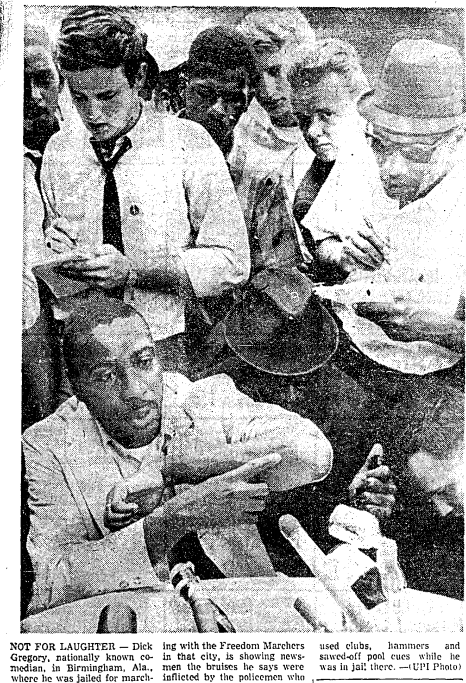
Those event-filled days began for Gregory on Oct. 12, 1932 in St. Louis, Mo., where he was born the son of Lucille and Presley Gregory. The early years of his life are graphically told in his autobiography, including the unrelenting poverty that was compounded by a neglectful and often abusive father. Once, during a classroom pledge of donations from the students’ fathers, he tried to convince his classmates that his father had contributed more than the father of another student, Helene Tucker, who he admired. He was admonished by the teacher in front of the other students after claiming is father had donated $15. “We know you don’t have a Daddy,” the teacher said.
He said that was a shameful moment and for days he refused to return to class. Eventually he did, working his way from the “idiot’s chair” and being defined as a “troublemaker.” But it would take years to push that embarrassing moment in the classroom from his life. “When I played the drums in high school it was for Helene; and when I broke track records in college, it was for Helene; and when I started standing behind microphones and heard applause, I wished Helene could hear it, too. It wasn’t until I was 29 years old and married and making money that I finally got her out of my system. Helene was sitting in that classroom when I learned to be ashamed of myself.”
At Sumner High School, Gregory excelled on the track and earned a scholarship in the sport to Southern Illinois University. He set records as a half-miler and miler, along with his activities in his fraternity, Alpha Phi Alpha. In 1954, he was drafted into the Army, where, at the urging of his company commander, he entered and won a number of talent shows.
He briefly returned to SIU after mustering out of service, but he ended his pursuit of higher education, concluding that the college was only interesting in exploiting his running ability.
When connections from his Army days gave him opportunities to renew his comedy bits, Gregory moved to Chicago and was quickly admitted into a circle of emerging Black comics—Nipsey Russell, Bill Cosby and Godfrey Cambridge. They represented a fresh crops of comics, who openly defied the vaudevillian, burlesque style chitlin’ circuit routines of the previous generation. Gregory, as he had done during his Army days, based his comedy around current situations and personal experiences, gradually commenting on the country’s Growing Civil Rights movement.
Mel Watkins, in his book “On the Real Side,” explained this transition. “Gregory had been interested in topical humor from the start of his career,” Watkins wrote. “Although he played Black clubs, where the patrons insisted on blue humor, he had resisted, weaving topical jokes into more risqué material and often annoying owners and customers.
“For a brief period in 1959,” Watkins added, “[Gregory] even opened his own club, the Apex in Robbins, Illinois, in which he could concentrate on the social satire that he preferred. Unlike his precursors, he had not been thoroughly groomed in Black circuit stage humor, which requires, among other things, that one be a funnyman or jester in the traditional sense.” In effect, the satire allowed Gregory to expand his range of humor, erasing any semblance of inferiority, and, as Watkins notes, “engaging” his audience “on an equal basis.”
During that same year in 1959, Gregory married Lillian and together they had 11 children.
The shifting political climate provided the perfect conditions for Gregory’s sharp, ironic wit to prevail, such as when he quipped that he was really for Abe Lincoln, who’d freed him from the open market. “You know the definition of a Southern moderate?” he’d ask. “That’s a cat that’ll lynch you from a low tree.”
Gregory’s involvement in the Civil Rights Movement presented him with a more intimate look at the turbulence troubling the nation. From this perspective, he was able to comment even more sardonically about race relations, to cleverly denote the longstanding hypocrisy.
As his popularity increased, particularly after an appearance on Jack Paar’s late night show, he appeared almost nightly on television or at some club or event. These appearances led to the recordings and more books, one of which “Callus on Our Souls,” a memoir derived from the final words in “Nigger.” He had cameos or feature roles in a number of films, and no social or political issues escaped his assessment.
With Mark Lane he weighed in on the assassination of Dr. King, which would be the inception of a number of conspiracy theories. He was a key speaker at many rallies against the war in Vietnam, in the late ’60s he ran unsuccessfully for mayor of Chicago and for the presidency and he voiced his opposition to the treatment of animals and began to offer his advice on health care, even introducing his own health drink.
Despite the onset of recent ailments, Gregory was as active as ever, and his fans were heartbroken to learn that he won’t be able to honor his November date at the B.B. King Blues Club & Grill.
But, posthumously, his book “Defining Moments in Black History—Reading Between the Lies” (Amistad) will be available and Gregory will continue to retain the spotlight he shared so brilliantly during his time among us.
One of the moments in his final book is a conversation with Rosa Parks, and she discloses what she was thinking about when she refused to give up her seat that fateful day in 1955. “I just couldn’t get Emmett Till off my mind,” she told Gregory. Of course, this fact has been known for years, but to have it told to Gregory gives it a special moment of resonance.
And, like his tumultuous life, Gregory engaged the notables in the book and helped them unravel the history of lies that he targeted so well during his turns behind the microphone, in front of the camera or at the lectern. Through him we found a way to laugh at life’s absurdities, even as we fought to eradicate the racism.
