


As the state’s June primary election approaches, the Greater Harlem Coalition (GHC) held its usual public forums with state assembly candidates in the 68th (East Harlem) and 70th (Central Harlem) districts to openly discuss community issues with voters and poll whom they are likely to vote for.
GHC represents the interests of Harlem block associations, nonprofits, faith-based organizations, and small businesses, with a focus on addressing the systemic issue of oversaturation of city shelters and state drug treatment centers in Harlem.
“We’re all united in the mission to make Harlem a place where everyone can thrive,” said GHC co-founder Syderia Asberry-Chresfield at the forum. The other co-founders are Dr. Carolyn A. Brown and community activist Shawn Hill.
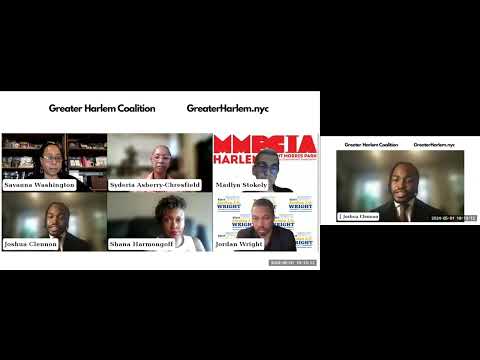
The 70th Assembly forum included three candidates: community advocate Shana Harmongoff, housing organizer Joshua Clennon, and campaign manager Jordan G. Wright. Other candidates, such as Alpheaus Marcus and Maria Ordoñez, did not attend. Several attendees seemed dissatisfied in the forum’s live chat, where they discussed candidate Craig Schley’s petitions to get on the ballot being challenged by Wright’s campaign. Incumbent Assemblymember Inez Dickens, who’s slated for retirement and has endorsed Wright as her replacement, tuned into the event and offered comments in the chat, but was not a part of the forum’s debates.
The 68th Assembly forum included three candidates: Community Board (CB 11) chair Xavier Santiago, district leader William Smith, and district leader Tamika Mapp. Incumbent Assemblymember Eddie Gibbs, who’s running for reelection, did not attend due to “unforeseen circumstances.”
According to the City Comptroller’s office, most predominantly white community districts have no shelters, and substance use treatment programs are much more likely to be in “neighborhoods with a higher percentage of people living below the poverty line” like Harlem and East Harlem.
Both forums covered similar topics related to this oversaturation issue, such as medical redlining, disenfranchisement, structural racism, battling addiction in communities of color, fostering mental health resources for the youth, and building up small businesses.
A large part of the discussions centered around Dickens’s bygone Fair Share A9571 bill, which limits the amount of addiction and substance abuse facilities to five within the jurisdiction of any community board; Congressmember Adriano Espaillat’s Harm Reduction Through Community Engagement Act of 2023 (H.R.2804); and Manhattan’s CB 11 and CB 10 moratoriums on New York State Office of Addiction Services and Supports (OASAS) centers from previous years.
The 70th candidates all discussed the existing bills and their approach to legislating for opioid and drug treatment facilities and shelters in the community. “We’re not going to arrest our way out of this,” Wright said. “Our folks have to be treated with love, kindness, and compassion. There is no universe where we’re going to send someone to jail and they’re going to end up in a better situation than when they went in.”
NYS Assembly District 70 Forum
NYS Assembly District 68 Forum

Harmongoff, a proponent for mental health resources, added, “I would invest in community-based prevention initiatives, education, and early intervention programs to address the root causes of substance abuse. A lot of times, there (are) underlying issues—people have lost their jobs, people are getting divorced, family members have died, so there are underlying issues that we first must tackle.”
Wright and Harmongoff supported reintroducing Dickens’s bill and strengthening the community board moratoriums, but Clennon called for new action.
“The community board is just an advisory board—it’s not enough,” Clennon said. “We need more urgency and more action from our state representatives. I’ve been in meetings with Shawn Hill (and) Syderia, with the heads of OASAS, and they seem to be intent on doing what they want and really disregarding the voices of our community, so we have to advance new legislation. A lot of candidates mention Inez’s bill that is in the State Assembly—unfortunately, it hasn’t gotten any support from any other of her colleagues in the New York State Assembly, so we need to advance new legislation that we can build a coalition around.”
In the 68th Assembly forum, the topic of community board moratoriums and collaboration was even more tense as Mapp and Smith took issue with Santiago’s position as board chair.
Since Dickens’s bill “hasn’t gotten any traction” in the Assembly, Santiago said he would propose legislation that would mandate approval from the community board and public for treatment centers, similar to how liquor licenses for restaurants require board review before the state doles them out.
Santiago defended his board’s moratorium and said the city’s health department has outrightly lied to them about building more shelters and centers. He said the board has been chasing down electeds, including Espaillat, about the oversaturation issue.
“Historically, the facts are the facts,” Santiago said. “We had a moratorium and they cited it here in the community without our permission. They did, and it’s factual: (a) lie to the community board.”
Smith said he would support Espaillat’s community engagement bill and that Santiago hasn’t done enough on the community board to change the situation. “I hear that you said that you’re an advisory component and I hear a lot of trying. The next assembly member needs to be someone who’s action-oriented and is results- and solutions-based, not focused on ‘I’m going to try’ and ‘I’m going to hear you out,’” Smith said. “We need people (who) hear people out and initiate and effectuate change.”
Mapp also pushed back on Santiago, saying no one at the community board has been listening or vocal about her resolution.
“Assemblymember Inez Dickens…has the bill, which has been in Albany for two years,” Mapp said. “The reason why it hasn’t been getting any traction is because our elected officials didn’t want to pick it up, so I have been writing a resolution to include the restriction—making sure that it resembles, like Xavier said, the liquor and the cigarette store [approvals]. I’m the first one that came out with that and (have) been working on that bill for the [past] four years. When we introduced it to the community board, it was always pushed back [by] the community board.”
The GHC’s end-of-the-event polling showed favor for Santiago and Smith in the 68th Assembly race based on the forum. In the polling of the 70th Assembly forum, half of the attendees said they’d vote for Clennon and a quarter for Wright.
Ariama C. Long is a Report for America corps member who writes about politics for the Amsterdam News. Your donation to match our RFA grant helps keep her writing stories like this one; please consider making a tax-deductible gift of any amount today by visiting https://bit.ly/amnews1.

This poll result is a little skewed. There were about 110 people on the zoom. Only 40 voted. Of that 40, Clennon had about 20 votes. Wright had about 10. Shana had 7, and Schley had 3.
Many of the voters didn’t live in the Assembly district. So what did this poll prove.
Furthermore, Clennon is no longer on the ballot, and Schley is in court trying to get on the ballot, although I recently heard that such attempt is over.
Marcus never turned in petitions. So really this race has come down to three people: Shana Harmongoff, Jordan Wright and Maria Ordonez. This fact has been known for awhile.
Would be great if Voters could have, say, 1-sentence bios on the Judicial Convention Dekegate candidates.