


Remembering the life and legacy of poet Nikki Giovanni, who died on Dec. 9 in Blacksburg, Virginia, after a long battle with lung cancer, begins with numbers: She received 27 honorary degrees from various colleges and universities; keys to more than two dozen cities; seven NAACP Image Awards; and authored numerous books of poetry. It would take a sizable gallery to showcase her awards and citations. She was 81.
Born Yolande Corneilia “Nikki” Giovanni, Jr. on June 7, 1943, in Knoxville, Tennessee, to Yolande Cornelia, Sr. and Jones “Gus” Giovanni, she and her family subsequently moved to Cincinnati, Ohio, where her parents began working at the Glenview School. Nikki, as she was called by her older sister, was four when they settled in the Black community of Lincoln Heights.

Giovanni returned to Knoxville 10 years later to live with her grandparents. She attended Austin High School and graduated early to attend Fisk University, her grandfather’s alma mater, but her rambunctious and rebellious behavior led to a dismissal from the school.
In 1964, she reentered Fisk and immediately joined several civil rights activists in their protest movement. She was active with SNCC and edited a student literary journal. It was during this phase of political development that she published her first article, in Negro Digest, through the intercession of David Llorens, who, she wrote, “Either thought I showed talent or he was exceedingly kind to a young Fiskite … It made my day.”
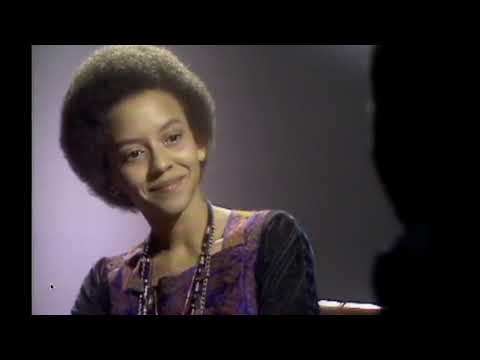
She later told Mari Evans, the editor of “Black Women Writers — 1950 to 1980, A Critical Evaluation” (1984), “My first published book was done by me and my friends. It was the book ‘Black Feeling, Black Talk.’ I formed a publishing company, borrowed heavily from my family and friends, and hired a printer.”
Her ascendance as a poet took flight along with Sonia Sanchez, Haki Madhubuti (Don L. Lee), and others during the Black Power phase of the movement. When she spat out the lines “Nigger! Can you kill/Can You kill, Nigger Can you kill, Can Nigger kill a honkie,” she captured the nation’s attention and signaled a mantra for the Black Arts Movement.
“When the revolution failed her,” wrote literary critic William J. Harris, “Giovanni turned to love and began writing a more personal poetry, signaling the onset of the second stage of her career.” To a great degree, her poetry marked the various social and political changes in her life, from “My House” (domestic love) to “A Poem Off Center” (refusing to be boxed in as a writer). “By the third stage of her career,” Harris noted, “love has failed Giovanni.”

In the early 1970s, there was a momentary lull in her poetry and she devoted more time to studying and giving birth to her only son, Thomas. In 1973, she published one of her most popular poems, “Ego Tripping,” which bears a similarity to Langston Hughes’s “A Negro Speaks of Rivers” with the lines “I was born in the Congo/I walked the fertile crescent and built the sphinx …”
Prior to this creation, she sat with James Baldwin for a riveting conversation that was captured by writer Rashida Briggs in “James Baldwin in Context,” edited by D. Quentin Miller. Of the dialogue, Briggs wrote that theirs was a “collaborative dance that demonstrates that one can love and have similar goals but also disagree about strategy. Their collaboration is a loving confrontation, wherein they come together and confront each other in a battle of wills and spirits.”

The timing of Giovanni’s death is ironic since it comes as the world continues to pay homage to Baldwin’s centennial birth celebrations.
Giovanni also received countless invitations to speak at colleges and institutions, and it was on such an occasion that Virginia Fowler, later to be her life partner, asked if she would be interested in teaching at Virginia Tech. She accepted and taught there until her retirement in 2022.
Much more space is needed to capture the full warp and woof of Giovanni’s prowess and production. We conclude with her words to Evans in her anthology, about why she wrote: “We write because we believe that human spirit cannot be tamed and should not be trained.” Nikki Giovanni was neither tamed nor constrained. In HistoryMakers, there is an extensive interview conducted in 2003 that illuminates much of her formidable days among us.

Rest In Peace Nikki Giovanni, you were always my favorite Poetress.
Rest In Peace Nikki Giovanni, you were, are and will be Black Treasure.
She was amazing! RIP Queen! A life worth lived!❤️❤️❤️❤️
rest in peace and Power, Thank you for your service