
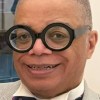

With nearly a thousand well-wishers filling the imposing colonnaded hall of the National Building Museum, the 2011 marriage and re-commitment ceremony of Corey L. McCathern and Reginald Van Lee was the Gay wedding of the decade. Recalling these auspicious nuptials, I asked Mr. Van Lee if marriage had required altering his accommodation? “Why no. But I don’t believe in storage. So, making room for new art is what can be challenging. I believe that art should be displayed prominently and accessible…”
Suave and astute, a product of MIT and Harvard, profiting in the process, Van Lee usually gets what he wants. Does being a perfectionist, determined to do his best, to please himself by pleasing others, arise from what human behaviorists describe as the need gay men have to overcome disappointing loved ones, by being the “best little boy in the world?” “I don’t know,” shares Gordon Chambers. “I just know that Reggie is the nicest friend I have.”
Van Lee has lamented that as a business venture, perhaps he ought to have acquired two works of art made available from a young and unknown Jean-Michel Basquiat. He’d declined the offer because the paintings didn’t appeal to him, he said, “not even after one sold for more than $110 million at auction.”

Dominating the family’s library above the sofa is an arresting painting by Tyler D. Ballon titled “The Pietà.” (Michael Henry Adams photos) 
The view across the East River from Van Lee’s penthouse apartment. 
Norma Jean Darden has catered Van Lee’s Parties for years. 
Friends seated on Van Lee’s terrace. 
A corner of Van Lee’s sophisticated living room. 
The living room sofa. 
African and Western art form a harmonious backdrop in Van Lee’s living room. 
Van Lee’s art nouveau bed is made from ornately inlaid marquetry.
Over a lifetime of collecting Black art, the principle Van Lee adheres to — to surround himself with art he adores — has had little to do with material value. It has been an approach that has served him well.
Take the sun- and art-filled Midtown East apartment on the 55th floor he’s called home since 1989. It’s offered for sale now, after his recent decision to retire full-time to the sprawling 20,000-square-foot compound he built in 2012 outside of Houston in Wharton, Texas. Inspired by a visit to the Kennedy compound on the Cape, his homestead occupies land acquired by his formerly enslaved great-great-grandmother in 1899, which his mother left him. It’s home for Van Lee and his sisters, their extended families, and their many friends. Each wing is a casita or a commodious individual apartment, connected, but attuned to the specific tastes of the occupant. The dining table, where the four siblings and their families gather, is large enough to accommodate 50. “The notion of the Kennedy compound and all this land came together in a really great way,” Van Lee says.
As to the apartment he’s giving up, a perfect place to entertain, Van Lee contends he loved it at first sight. Perched high above the East River with unobstructed views, “I expected it to appreciate in value,” says Van Lee. “And it has.”
‘[His] apartment,’ I told Van Lee, ‘reminded me of the plight of Valerie Jo Bradley when she worked at the United Nations for Andrew Young. She had moved near here,’ I said. ‘Her apartment also had a large terrace. It was perfect for the diplomatic cocktail parties she’d host. But whenever she did, screaming racial epithets, her ‘elegant’ white neighbors would call the police with noise complaints. They would also rain garbage down on her guests,’ Val has told me. Have you ever encountered such biases?’ I asked? “As a Black man in corporate America,” Van Lee noted, “I’ve been in many rooms where I know I’m not wanted.” This was never his experience at his apartment building though. “Although I had looked earlier at some buildings where I was instructed to use the service entrance, I never encountered racism here. Here, the concierge was a Black man. I could see he was cheering for me to move in. So I felt instantly welcomed,” he laughs.
Attendant to acquiring wealth at the consulting firm Booz Allen Hamilton, Van Lee has also worked assiduously at giving back to the community. Even in retirement, he maintains seats on the boards of numerous cultural and charitable institutions nationwide. Having had the pleasure over the years of attending Van Lee soirées to benefit everything from the Evidence Dance Company to the Studio Museum in Harlem, I’ve been struck by their continuity of conviviality.
Most recently, he hosted a breakfast reception to introduce congressional candidate John “Jack” Bouvier Kennedy Schlossberg to 50 Black civic and cultural leaders. Composer Gordon Chambers, philanthropist Loida Lewis, Khephra Burns, and Susan Taylor — the usual humanitarian suspects were all there, attended to by caterer par excellence Norma Jean Darden and her ever-capable staff. Sitting outside in the sun afterward, how pleasant it was to bask in the afterglow of hope for a new Camelot. But considering, too, the end of an era, it was, as well, bittersweet.

Checking your browser sounds interesting. Did you find any specific tips that were surprising?