


More than a week after a 7.4 magnitude earthquake struck Colombia, Afro-Colombian aid groups are desperate for help.
The earthquake struck the Chocó region near the city of San José del Palmar on Aug. 10 at 7:34 a.m. According to the U.N.’s ReliefWeb, the quake’s tremors caused damage throughout Chocó, a region with a majority Black and Indigenous population, and was felt as far away as the capital city of Bogotá. It even caused vibrations in the neighboring countries of Venezuela, Panama, and Ecuador.
Entire villages were flattened in Chocó, and aftershocks triggered landslides that have blocked roads into and out of the area, slowing rescue efforts and the delivery of food, medicine, and emergency supplies.
Zulia Mena, a former mayor of Chocó’s capital city, Quibdó, told AmNews that damage was evident almost everywhere you looked. Mena is working with the Organización de Barrios Populares del Chocó (OBAPO) to bring help to earthquake victims.
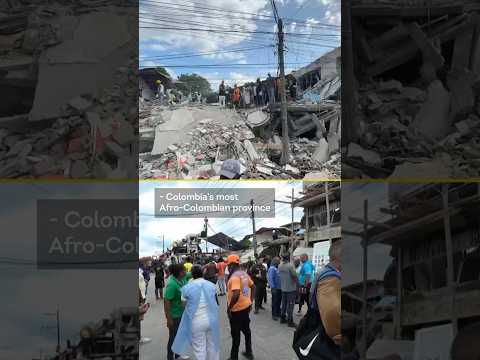
“Right now, today, August 15, we are in Futuro Dos in the northern zone [of Quibdó] with a mental health team and doctors supporting the community,” Mena said. “We are supporting the community by organizing community meals, holding mental health talks, and providing food packages.” OBAPO is also looking for donations of building materials and assistance for female-headed households who lost their homes.
Historian Sergio Mosquera posted videos documenting the damage the earthquake caused at the Muntú-Bantú Foundation, the Afro-diasporic cultural and educational organization he founded in 2004. Mosquera said he created Muntú-Bantú because Colombia has the third-largest population of Afro-descendants in the Americas, “yet we didn’t have a place where our story was told. Because in the country’s museums our stories aren’t told; we’re excluded.”
Over the years, he filled the space with art and sculptures from around the world and worked to make it a place of pride for Black people in Colombia and across Latin America. The center also has a special room called “Moleques en Palenquito.” “Moleques” refers to enslaved children and “palenque” means a place of freedom. In Moleques en Palenquito, instructors teach children — regardless of their ethnic background — to read and interpret the world through an Afro-diasporic lens, so they can see themselves in books and movies as beautiful and intelligent people.
Muntú-Bantú’s entire four-story building sustained cracks because of the earthquake, but the third floor saw the most damage and was practically destroyed. “We are now in the process of restoring the pieces — first by rebuilding the structure. We’ve already started to … clear away the debris. We’ve begun rebuilding the facilities, and after that, we’ll curate the pieces that can be recovered — and those that I believe may have been lost. But anyway, we’re here to rise again like the bird, the phoenix.”

Credit: OBAPO.
Muntú-Bantú is open to contributions for the center’s upkeep, maintenance, and restoration. The foundation can accept both in-kind contributions, like sculptures, and cash to help cover the costs of materials and labor.
Black-led diaspora groups are also responding to the emergency in Colombia. Jarvis Houston and Alix Jean of Alphas in Colombia, a group of Alpha Phi Alpha Fraternity, Inc. members living in Colombia, have organized a relief drive to connect U.S.-based donors with supplies headed for Cali and then Chocó.
“Service does not stop at borders,” Houston said. “As Alpha men living in Colombia, we have a responsibility to stand with the communities we call home when they need us most. We are asking our brothers, members of the Divine Nine, friends, family, and supporters across the United States to help us turn that commitment into immediate action.”

Houston said the group has already collected more than 200 supplies and hopes to transport more than 500 emergency relief items to Chocó on Sept. 12. Volunteers from across Colombia are expected to gather in Cali, coordinate with local nonprofits, churches and community leaders, and help move supplies into Chocó. Requested items include first-aid kits, gauze, diapers, wipes, masks, air mattresses, flashlights, batteries, hygiene products, portable chargers, emergency blankets, sleeping mats, and water-purification supplies.
Jean, who previously worked in earthquake relief in Haiti, said the relief work cannot stop with a single delivery. He said medically trained volunteers, including a retired Air Force medic and a pharmacist, are preparing to offer free services, while organizers are still trying to secure volunteer housing. “But it’s not just going to be giving out supplies, it’s also about rehabilitation and rebuilding.”
Those who want to support the cause from the United States can attend the SOS Chocó fundraisers being organized by Afro-Latino Festival NYC. They have arranged two open-mic events to raise funds that “will directly support Afro-Colombian organizations doing vital work on the ground, including Casa Cultural El Chontaduro and Afro Cabellos.”
“Before the earthquake, AfroLatino Festival NYC and Afro Resistance organized a Trans Delegation to Colombia, bringing together more than 20 Black trans producers, cultural programmers, artists, and community leaders to facilitate workshops, educational programming, and cultural exchange at the Petronio Álvarez Festival,” Afro-Latino Festival NYC said in a statement. “When the festival was canceled in the aftermath of the earthquake, the impact was felt deeply across Cali and surrounding communities. Afro Resistance was already on the ground with members of the delegation, witnessing the urgent needs of communities directly. We are turning our presence and relationships into action.”

Credit: Sergio Mosquera
The first SOS Chocó event was held at Mi Casita BK on Aug. 18, and the second will take place at Palenque Restaurant at 298 Graham Ave., in Williamsburg, Brooklyn, on Aug. 21. More fundraisers are already being scheduled.
The recovery work in Chocó is expected to take years. So far, the Colombian government has been present, but mainly as an intermediary. Mosquera told the AmNews the government is mostly working “as a coordinator of aid, because right now what we’ve seen is national [nonprofit] and international aid that has arrived. People are very committed to helping, but as for a plan the government has or resources it’s investing in recovery, reconstruction or aid — no, it’s just administering the resources, and the effects of that haven’t been felt yet.”
Local and Black diaspora organizers stress that solidarity is going to be crucial in helping Chocó residents recover from the effects of the Aug. 10 earthquake.
