

On view at Water Mill’s innovative Parrish Art Museum in the Hamptons, “Sanford Biggers: Drift On” presents a major solo exhibition of the acclaimed Black artist’s oeuvre. The retrospective enriches the East End of Long Island through September 13, featuring new textile works, prints, and sculptures, and even including site-specific installations.
Fascinated by both the inherent nature of materials and the power of symbols, such as clouds, which have intrigued him for decades, Biggers was born in Los Angeles, like quilt artist Michael Cummings, in 1970. He now also lives and works in New York City. Moreover, after a fashion, he too is a quilt artist.
As such, his work also represents the same sort of magical-seeming alchemy, transforming what might appear to be components of little value, either intrinsically or even symbolically, into the rarest kind of esthetic treasure; manifesting majestic beauty and imparting meaning and spiritual uplift to the viewer.
Here, though, is where similarity ends. Instead of the continuity Cummings perpetuates, although frequently relying on the geometric grid of the ancient quilting craft, Biggers describes his process as “conceptual patchworking … a method of transposing, combining, and juxtaposing ideas, forms, and genres that challenge traditional historiography, provenance, and official narrative to create artworks for a future ethnography.”
An intricate interplay of perspective and history, big, small, or sometimes gigantic, his creations always use the Black past as a means of exploring today’s contextual circumstance.
A onetime breakdancer, musician, fine artist, and cultural commentator, Biggers is the creative director and keyboardist of the conceptual performance collective Moonmedicin. It was in this capacity that he received a recent Grammy Award for their “The Omnichord Real Book,” recognized as the 2024 Best Alternative Jazz Album.
Biggers’s diverse approach is born from his rarified position as a collaborator. However, rather than employing what is often an emotive point of departure like other artists, such as Cummings, Biggers is more deliberate. There is nothing tentative or ambiguous about his employing antique quilts and textiles, or sampling iconic sculptures from around the world, such as Antonio Canova’s “Dancer with Finger on Chin” (1809–1814, Museo Canova). Celebrated for conveying grace and weightlessness in the weighty solidity of stone, this nymph was the precursor for Biggers’s “Mirror” (2024), a monumentally scaled marble combining ancient African masks and Greco-Roman neo-Classicism.

Harlem’s Roy Paul and Jean Garrett enjoy Biggers’s “Unsui,” as instructed. (Michael Henry Adams photo) 
Caption gives instructions for best way to experience Biggers’s “Unsui.” (Michael Henry Adams photo) 
Biggers’s monumental marble “Mirror” from 2024, derived from Canova’s early 19th-century dancer and African masks. (Michael Henry Adams photo) 
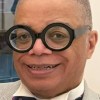
Roy Paul of Harlem and the Hamptons with friend John Wyche. 
Dining al fresco at Bridgehampton Inn, the Hampton’s best restaurant.
At the Parrish Museum, this impervious-seeming monument is juxtaposed amid decorative eroded rock particles that Biggers has employed to address delusional humanists’ conceptions of time, permanence, powerlessness, and materiality. Biggers informs the viewer directly via an interactive video.
The recipient of innumerable accolades, including the Smithsonian Artist Research Fellowship, Morehouse College’s Bennie Trailblazer Award, a Guggenheim Fellowship, the 26th Heinz Award for the Arts, American Academy of Arts and Letters Award, 2017 Rome Prize in Visual Arts from the American Academy in Rome, and deFINE Art Award from Savannah College of Art & Design, Biggers was also inducted into the New York Foundation for the Arts Hall of Fame and is a National Academician of the National Academy of Design. In addition, he was the Dr. Martin Luther King, Jr. 2021–2022 Visiting Professor and Scholar in the MIT Department of Architecture and an associate professor of sculpture and new genres of visual arts at Columbia University from 2009 through 2018.
How disconcerting it is to be bidden by so august a figure to participate in the evolution of his creative process. Unfixed, over the course of the exhibition, the colored sands of his piece “Adrift” (2026) have been unavoidably disrupted by the movements of museum visitors. Hard lines soften. A strict geometry becomes steadily eroded, the work’s boundaries metamorphosing into a painterly effect, creating what Biggers refers to as a “blur.” Building on the exhibition’s exploration of movement and transformative forces, this blur is also echoed in examples of Biggers’s quilt-based Codex series, in which the textile’s quilted pattern appears to have been smeared or brushed away by a source unseen and unknown.
For those whose guiltiest pleasure is to touch and share a tactile experience, what a delight it is to encounter Biggers’s “Unsui” (“Cloud Forest”) from 2025. Inspired by his primal experience of clouds in the Japanese landscape, the island-like quilts among cloud cutouts offer a refuge where the museum-goer is bidden to be at home: “Visitors are invited to sit on the quilts and listen to the artist-curated playlist” instructs a caption.
The artist has said that this work embodies his new engagement with clouds from when he began spending time in Sag Harbor’s Sag Harbor Hills, Azurest, and Ninevah Black subdivisions, founded by middle-class families during the post-WWIl era. “It’s an enclave of aspirational African American families that have been there for decades; in some cases, close to 100 years,” Biggers explained. “The fact that I had entrée into that type of community was something that I hold very dear.”
To honor the significance of this place, Biggers said he looked to the landscape around him: “What I wanted to do was show something that was more experiential, maybe visceral and abstract, which is really just the feeling of being at ease, at comfort in a community that is on the water, with beautiful vistas and a great cloudscape. I often talk about clouds in relationship to potential and ephemerality. I think it’s also in the eye of the beholder. Everybody can see the same cloud yet see different things. I feel like Sag Harbor is an experience like that, too.”
After enjoying our Parish Museum visit, my friends Jean Garrett and Roy Paul thanked our good fortune to be able to discover so much to do in the Hamptons that’s soul-satisfying and speaks so meaningfully of the Black experience. Then, at the Bridgehampton Inn, with Alan Alda dining nearby, we had a marvelous dinner, truly exceptional, at the Hamptons’ finest restaurant. At all the best eateries in this area, it’s notoriously difficult to secure a weekend reservation, proving that whoever one is, it’s important to have a host who’s an old friend of the maître d’; in this case, John Wyche.
There may not be as many African American homeowners in the Hamptons as there once were, but thank goodness, there are still Black people strategically placed in today’s Black Hamptons!
